Keywords: Masdar, zero carbon city, UAE, United Arab Emirates, peak oil, climate change, global warming, electric cars
Masdar, the world’s first zero-carbon city, pokes a sustainable finger in the eye of the oil-addicted west. Masdar, created by the United Arab Emirates (UAE) government, is an ultra-sustainable city growing up in the desert outside of Abu Dhabi.
The irony of this:
- The oil-addicted west consumes vast amounts of oil, funding the middle east’s oil-free sustainability initiatives.
- As the US contines the love affair with gas guzzling SUVs, Masdar outlaws combustion-engine vehicles, replacing them with a network of electric cars.
- As western powers bicker over global warming details, Masdar shades itself from the warming world with rooftop arrays of solar panels.
- Partnering with MIT, Masdar’s Institute of Science and Technology offers programs in science and engineering with a focus on sustainability and renewable energy.
The Masdar development (detailed below) is designed by the British architect Norman Foster. In an interview with Time’s Bryan Walsh, you can feel Fosters frustration:
“It shows there is another side of this place that is totally unexpected. I think that as you read about some of this in Western newspapers, you’ll be shocked. Your immediate reaction would be, Why aren’t we doing this? We’re expanding London, and we’re just repeating the old model of sprawl. Why elsewhere is there not one experiment like this? Why not in the U.S., with its total dependence on oil? Why can’t this collective of European wisdom and power create a similar initiative? I have to ask myself, Why is this initiative, which in urban terms is the most progressive, radical thing happening anywhere, happening here?”
The oil-rich UAE isn’t doing this because they can – they are doing it because they must. Masdar is a model city for the hotter, less secure, walled-city future of a post-petroleum climate-changed world.
The UAE, with just 4.5 million people, but billions in oil money, has funded a rapidly expanding infrastructure. As a country matures, their social complexity increases, along with energy consumption. It takes vast energy to build and operate cities. And Dubai, at the heart of the UAE has become an icon of conspicuous consumption. They already consume more natural gas than they can produce, becoming a net importer to feed the need for electricity. Hence Masdar’s emphasis on solar power.
Using GapMinder’s Trendalyzer with energy consumption data from BP’s Statistical Review of World Energy 2010 and income data from the IMF, we can see some powerful trends unfolding in the UAE. (N.B. data presented for 1965 through 2008, 1 year steps, circle area proportional to population size, per capita energy use in tonnes of oil equivalent).
Note UAE’s (the green line) stunning near vertical increase in per capita energy consumption over the past 20 years.
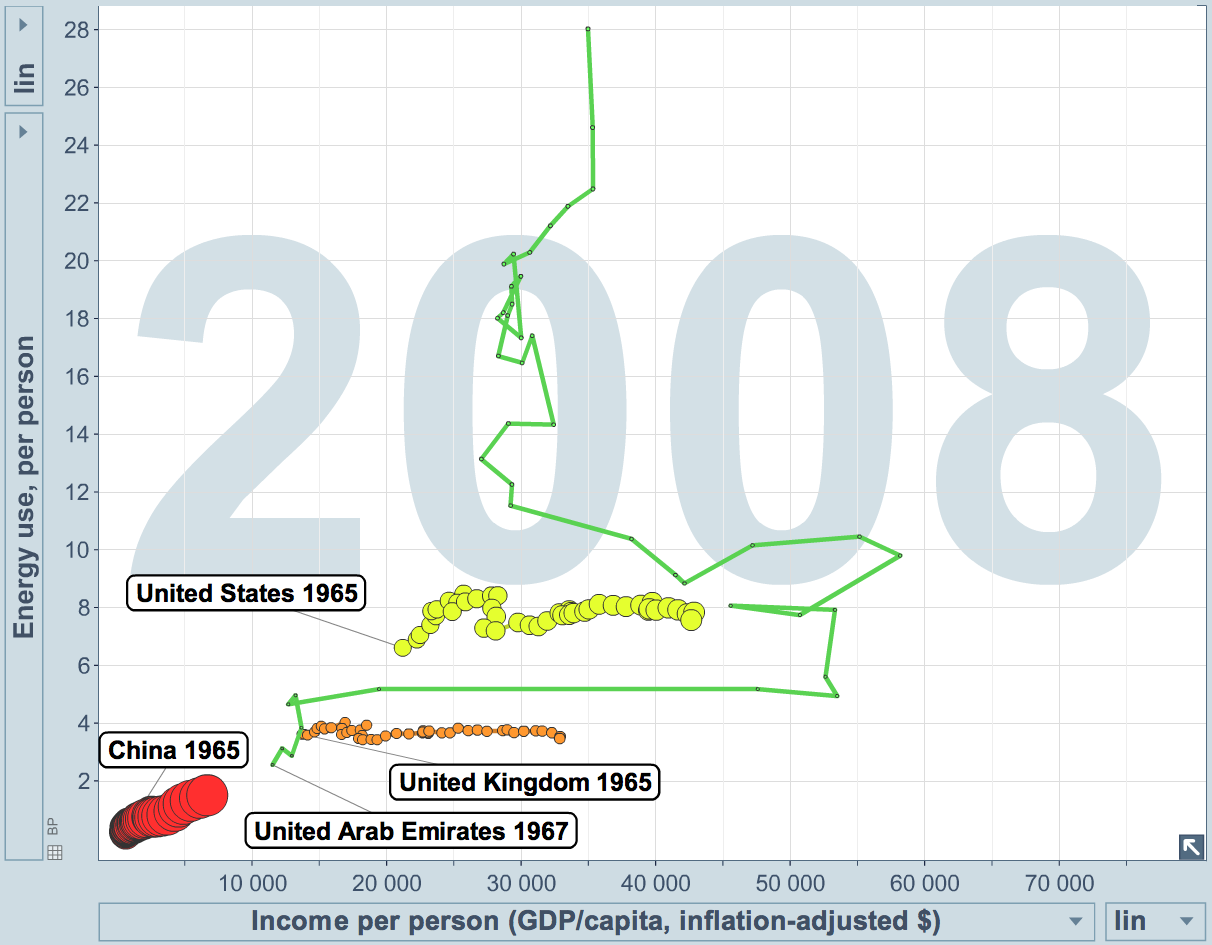
With an eye to their future, as global oil production peaks (middle east oil experts predict 2014), the UAE is laying the foundation for a sustainable future.
Highlights of In Arabian Desert, a Sustainable City Rises
Architecture critic Nicolai Ourousoff reports on Masdar in the New York Times:
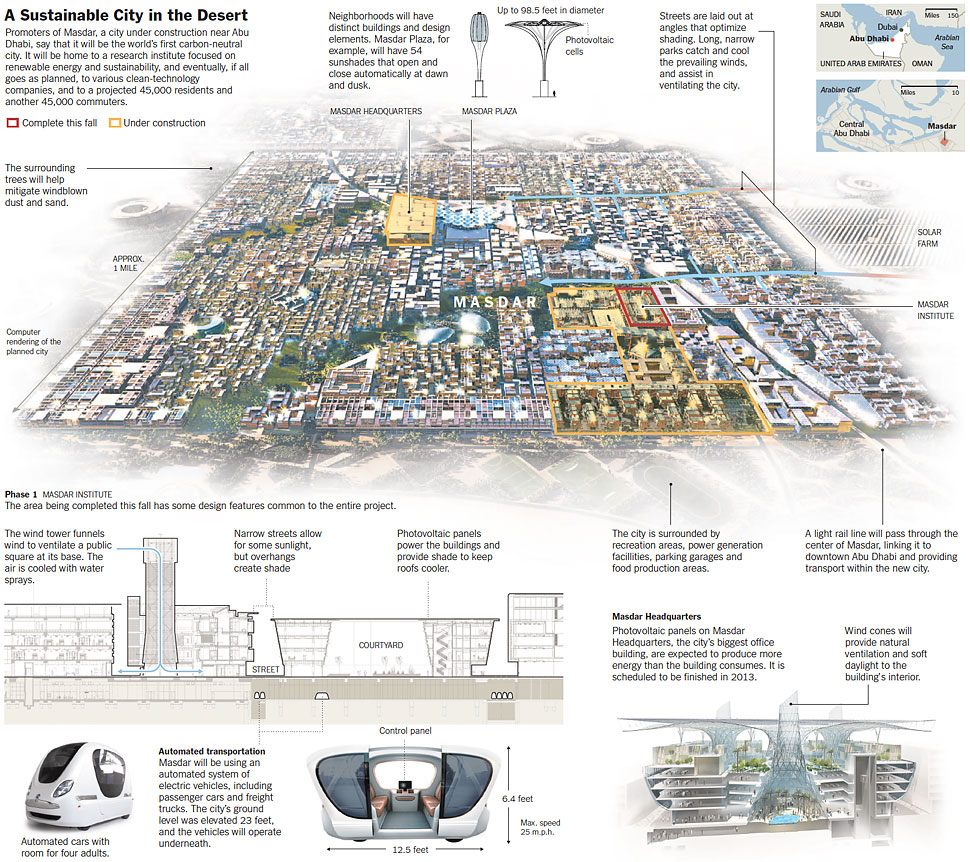
Designed by Foster & Partners, a firm known for feats of technological wizardry, the city, called Masdar, would be a perfect square, nearly a mile on each side, raised on a 23-foot-high base to capture desert breezes. Beneath its labyrinth of pedestrian streets, a fleet of driverless electric cars would navigate silently through dimly lit tunnels.
Norman Foster, the firm’s principal partner, has blended high-tech design and ancient construction practices into an intriguing model for a sustainable community, in a country whose oil money allows it to build almost anything, even as pressure grows to prepare for the day the wells run dry. And he has worked in an alluring social vision, in which local tradition and the drive toward modernization are no longer in conflict — a vision that, at first glance, seems to brim with hope.
But his design also reflects the gated-community mentality that has been spreading like a cancer around the globe for decades. Its utopian purity, and its isolation from the life of the real city next door, are grounded in the belief — accepted by most people today, it seems — that the only way to create a truly harmonious community, green or otherwise, is to cut it off from the world at large.
He began with a meticulous study of old Arab settlements, including the ancient citadel of Aleppo in Syria and the mud-brick apartment towers of Shibam in Yemen, which date from the 16th century. “The point,” he said in an interview in New York, “was to go back and understand the fundamentals,” how these communities had been made livable in a region where the air can feel as hot as 150 degrees.Among the findings his office made was that settlements were often built on high ground, not only for defensive reasons but also to take advantage of the stronger winds. Some also used tall, hollow “wind towers” to funnel air down to street level. And the narrowness of the streets — which were almost always at an angle to the sun’s east-west trajectory, to maximize shade — accelerated airflow through the city.
With the help of environmental consultants, Mr. Foster’s team estimated that by combining such approaches, they could make Masdar feel as much as 70 degrees cooler. In so doing, they could more than halve the amount of electricity needed to run the city. Of the power that is used, 90 percent is expected to be solar, and the rest generated by incinerating waste (which produces far less carbon than piling it up in dumps). The city itself will be treated as a kind of continuing experiment, with researchers and engineers regularly analyzing its performance, fine-tuning as they go along.
But Mr. Foster’s most radical move was the way he dealt with one of the most vexing urban design challenges of the past century: what to do with the car. Not only did he close Masdar entirely to combustion-engine vehicles, he buried their replacement — his network of electric cars — underneath the city. Then, to further reinforce the purity of his vision, he located almost all of the heavy-duty service functions — a 54-acre photovoltaic field and incineration and water treatment plants — outside the city.
It’s only as people arrive at their destination that they will become aware of the degree to which everything has been engineered for high-function, low-consumption performance. The station’s elevators have been tucked discreetly out of sight to encourage use of a concrete staircase that corkscrews to the surface. And on reaching the streets — which were pretty breezy the day I visited — the only way to get around is on foot. (This is not only a matter of sustainability; Mr. Foster’s on-site partner, Austin Relton, told me that obesity has become a significant health issue in this part of the Arab world, largely because almost everyone drives to avoid the heat.)
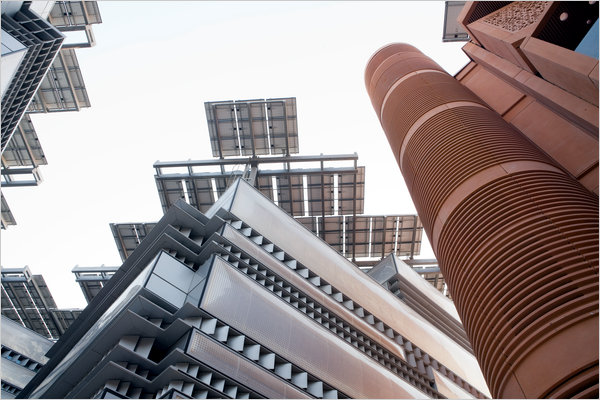
The buildings that have gone up so far come in two contrasting styles. Laboratories devoted to developing new forms of sustainable energy and affiliated with the Massachusetts Institute of Technology are housed in big concrete structures that are clad in pillowlike panels of ethylene-tetrafluoroethylene, a super-strong translucent plastic that has become fashionable in contemporary architecture circles for its sleek look and durability. Inside, big open floor slabs are designed for maximum flexibility.
The residential buildings, which for now will mostly house professors, students and their families, use a more traditional architectural vocabulary.
What Masdar really represents, in fact, is the crystallization of another global phenomenon: the growing division of the world into refined, high-end enclaves and vast formless ghettos where issues like sustainability have little immediate relevance.
For more on Zero Carbon initiatives, see:
caribousteaks says:
But where did the steel come from? How long will the solar panels last before they need to be replaced? What about the raw materials used to build the city? How indeed does Abu Dhabi get electricity? Natural gas? I applaud Abu Dhabi for their effort but I think the rhetoric is nonsense. Without oil and gas that place would not exist. Without mining for raw metals, rare earth metals, plastics, etc….its all a false fantasy. Roads are made of oil, plastic is oil and gas, solar panels require glass, plastic, metal, rare metals and need to be replaced every 15 years or so. Without oil and gas revenue would this city be built? NO! Why are there not more of these being built? Because no one has flippant amounts of cash to blow on fantasy projects that cost the earth and deliver very very little. Still as a show case project, its great, kind of like a concept car, impractical and irrelevant to all but the architects and designers in the studio.
Jay Kimball says:
Sure. It takes energy to build. The “zero” comes from the net of the equation – the cost and the profit. For example, the solar panels you mention, over the life of the panel, produce from 25 to 50 times more energy than they consume. When the panel needs to be replaced, it will have returned more value than it consumed. And the science of photovoltaics will have advanced when they need replacement, and the next panel will be even better.
The Energy Returned on Energy Invested (ERoEI) for things like solar and wind are are about 50:1 and steadily improving. Fifty years ago, oil had an ERoEI of about 100:1. Now, with the easy oil gone, the cost to explore and produce oil yields oil with an ERoEI of less than 10:1. Fossil fuels are our past. They will be around for a while, dwindling, but the future is renewable cleaner energy.
Regarding building roads and such, progress doesn’t need to stop if there is carbon emission involved. We just need to make sure the cost is balanced by the benefits. For example, you can emit carbon to make steel, and plant trees that capture the carbon. And the maker of the steel doesn’t need to be the planter of the trees. We have a good idea of the emissions, and create incentives to reduce emissions, and balance the emissions with CO2 uptake through other agencies.
Whether going to the moon, engineering a taller building, advancing medical imaging technology, etc., the endeavor is usually preceded by a bold vision. Masdar is an example. We are funding their vision. Let’s fund our own.
And as with going to the moon, the side effect of an endeavor such as this yields untold spinoff innovations that provide added benefit. Look at all the advances that came from the Apollo program – material sciences, electronics, imaging, telecom, medical, aircraft design, Tang ;-), etc.. For just one example – medical benefits – see this article.
And while going to the moon was in many ways symbolic, transitioning to renewable energy provides real benefit for us and generations to come.
Tom Poole says:
Caribousteaks, well said. Well informed.
Jay Kimball, my opinion is that you’re dangerously close to cloud nine! Your examples all seem poor or actually wrong to me, and their number can not strengthen them.
Don’t take my word for it but please, check again.
You sound good and intelligent to me, from what I read here, but I think wishful has given you a consistent bias. Well I have some really good news for you, which is that CO2 causes no environmental harm whatsoever, only good, because it’s plant food. Validation is not confirmation; the theory of man made global warming gets ever more elaborate, purely for the sake of its validation, while we still have zero confirmation of it.
Again, don’t take my word for it but please, check again. And keep in mind the words “validation is not confirmation”, as you check.
I do agree that we should conserve resources and that fossil fuels can be used for other things, but assuming we won’t discover any more oil, you’ll keep being surprised by the fact that peak oil is apparently getting further away. Even so, it’s already a lot further off than politicians would have you believe! Even if we did stop discovering any more, there would be no crisis for a long, long time.
And yet again, don’t take my word for it but please, check again. And again, keep in mind the words “validation is not confirmation”, as you check.
It’s much harder to find a sensible analysis of peak oil than it is to find the truth on most sources of common bunk, including climate change. How curious. Is there a clue here, about the motives behind the global warming scam, and the perversely lopsided funding of climate science? I can only speculate.
It wouldn’t be the first time governments have found reasons to lie to their people, that some resource is scarcer than it really is.
Tom Poole says:
Oh and Jay, your comment about planting trees to make up for making steel did make me laugh! Thankyou!
Do you know just how much energy is involved in making steel? I don’t think trees will do much! It’s a question of magnitude!
Seriously, valuable as trees are, this stuff about them being the lungs of the planet is nonsense. Magnitude, magnitude, magnitude. The green algae of the southern oceans are the lungs of the planet!
There are numbers involved!
Your ideas about cost/benefit can appear valid but only if we remain ignorant about the actual numbers. What you’re really doing is proposing some questions to ask, to ascertain the feasibility, and not providing the answers. Well people have thought of those questions already, I’m afraid, and the answers are quite negative. The above article is stupidly optimistic even compared to most.
As I say though, don’t take my word for it…
Jay Kimball says:
Hi Tom,
Thanks for sharing you views on climate change and peak oil.
Regarding your comments on climate change – though the media plays up the extreme ends of the issue, and the casual reader can come away with a sense that things are not resolved, business and government leaders have understood the problem well enough and are taking action.
Readers should do their homework, and many are. An excellent review of Climate Science can be found at Stanford University:
Climate Change Overview
And for a good review of climate skeptics, see:
Climate Change Contrarian Overview
And for a good commentary on the role media plays in the climate change discussion, see:
Climate Change Media Coverage
For folks that have done their homework and arrived at a concern for climate change and want to make sure they are part of a solution, and not part of the problem, this is a tremendous time to make a difference. This sort of problem will just get exponentially more expensive to resolve over the course of time.
Business and government leaders think the climate is warming, and that humans make a considerable contribution to that warming. They are paying attention to warming trends, and how it will impact business directly, and indirectly, as it impacts the consumer. Moving beyond the rhetoric of left and right, business is building a base in the pragmatic middle.
As with past technology transitions, there will be those that stick with business as usual, and those that have a vision and are part of the solution. See The Innovator’s Dilemma by Clayton M. Christensen for examples of companies that failed to respond to changing business conditions. The transition to cleaner renewable energy is underway. And as I mentioned in the post above, I would rather see our dollars invested in us than fund oil nations.
When Walmart CEO Lee Scott first articulated a sustainable vision for Walmart in 2005 he said “We must operate in a world that is healthy.“ A healthy world = healthy consumer = healthy business. For an example of how the biggest business in the world is partnering with one of the greenest to become more sustianable, see:
http://8020vision.com/2010/07/01/walmart-partnering-with-patagonia-on-sustainable-business-practices/
A diverse bunch of CEOs from Lockheed, GE, Cummins, Bank of America, Kleiner Perkins, Xerox and Microsoft layout their concerns on climate change, and a need for rapid transition to renewable energy, and their plan on how to get there at:
http://8020vision.com/2010/09/10/top-business-leaders-deliver-clean-energy-plan/
Also, as the world warms, insurers are trying to cover their exposure. See Lloyds view of climate and energy security at:
http://8020vision.com/2010/07/12/sustainable-energy-security-strategic-risks-and-opportunities-for-business/
And finally, for insight into the impact on agribusiness, see the Department of Agricultures excellent paper at:
http://www.climatescience.gov/Library/sap/sap4-3/final-report/default.htm
Farmers are using that report as a guide how climate change is damaging crop yields and changing what can be grown where. It is an example of government acting prudently to make sure food production stays on track. As the Spanish proverb says: “Civilization and anarchy are only seven meals apart.”
And on the investment side, savvy money manager Jeremy Grantham sums up his investment perspective at:
http://8020vision.com/2010/08/02/jeremy-grantham-everything-you-need-to-know-about-global-warming-in-5-minutes/
Regarding your comments on peak oil getting further away, the estimates of the peak in oil production by EIA and others have been closing in. They used to estimate 2050 time frame, and then 2030, now we are seeing detailed analysis from OPEC nations, for example, that suggest it may be about 2014. It might be we are there now, but it will take a few years to confirm that as we skim along the top and depending on if the world lifts out of the recession and resumes heavier consumption. The easy oil is gone and the ERoEI and cost of discovery and extraction are going up. Fossil fuel will be with us for a long time, but is our past. Cleaner renewable energy sources are our future.
For more on peak oil, and an example of what governments are thinking about peak oil, see:
http://8020vision.com/2010/09/03/german-military-study-warns-of-potential-energy-crisis/
For an example of how the US military is planning for the impact of climate change and peak oil, see:
Department of Defense Perspectives on Climate Change and Peak Oil
As I say above, though the media likes to give weight to the extremes on these issues, most governments and business leaders have moved beyond skepticism and are now in the planning and mitigation stages. And that’s a good thing.
NoName says:
Man I cant believe a spammer dragged me to another dumb peakoil site.
I still remember when you paranoid idiots said peakoil was going to happen in 2006, and I almost had a nervous breakdown because it was 2004 and according to you assholes life was going to be like in The Road.
First of all you idiots, there have been countless climate changes in this POS planet, all of them before civilization kicked in, and at least 9 MASSIVE EXTINTION EVENTS that killed almost everything.
Dinosaurs? the permian, the biggest dieoff ever happened much before dinos were walking around.
Why is that no peakoil paper comes from a respectable source? I mean seriously, the military? the same idiots that wanted to blow up the planet for the sole purpose of doing it before someone else did it? are you guys retarded or just high?
Jay Kimball says:
Hello NoName. I can see you are frustrated with peak oil and climate change topics. And I am sorry to be a further source of frustration for you.
There is a lot of good information pro and con on peak oil and climate change. One of the best analysis I have seen is Forecasting World Crude Oil Production Using Multicyclic Hubbert Model, which can be found at:
http://pubs.acs.org/doi/abs/10.1021/ef901240p
Nailing down a peak is tricky, and the peak can only be known for sure once we are beyond it by a few years. Hubbert did a very good job calling the peak of oil production in the US (early 1970s).
I think one of the important things about when the global peak will happen is that most of the folks in the energy information business, and many of the CEOs of global oil production companies have been converging their estimates into this decade. It used to be those estimates of global peak were out at about 2050. Now it appears we may be at peak very soon.
Though there are alarmists that talk doom and gloom about what will happen when we hit peak, I am not one of them. Post peak, we should expect prices for oil based products – gas, food production, etc. to inflate. But the prices can only go up so much before recession ensues and economies slow and pressure is reduced, slightly. That will have the effect of extending the top of the peak and easing the slide. It is widely understood that the easy oil has been used. Oil exploration and extraction will get more complex, and more expensive.
Increased oil cost will have the effect of speeding our transition to more renewable energy sources, since relative pricing will become more favorable. The transition will take time, and will challenge all of us.
What are your thoughts on peak oil? Do you see any limits to how much oil can be pumped per month? Are you saying there will never be a peak? If you see a peak, how do you see that playing out?
Regarding climate change, it sounds like you see the climate as changing, but that it is a natural thing, that has happened in this way many times before. Sounds like you don’t think CO2 and anthropogenic global warming are a factor. What are your thoughts on the change, and what, if anything, should be done?
Dharma says:
UAE made all their money from selling the black snake oil of Development and inviting black money from all over the world; from corrupt leaders, business people and celebrities. Now they make this enclave of technopia which is possible only with a huge pile of ill-gotten capital. Why participate and celebrate in yet another one of their branding campaigns?
jaykimball says:
Hi Dharma, Thanks for your comment.
As I point out in the article, there is a deep irony that the West’s addiction to oil helps fund excesses in the Middle East. My hope is that in putting a spotlight on how those nations are leading on technologies that can get us off the addiction, the West will get busy leading the transition to a cleaner sustainable world.